ChemVault
Bioactivity datasets and modelability
 ChemVault
Traceable target-centered bioactivity dataset construction and modelability assessment


Scientific purpose
ChemVault is a Python application for constructing and curating molecular datasets and assessing the modelability of eligible bioactivity datasets. It supports CSV imports and target-centered bioactivity dataset construction from PubChem.
In the target-centered workflow, a biological target is specified by a UniProt accession or resolved from a gene symbol and supported organism. ChemVault retrieves associated compounds, bioassays, and structured activity records and stores their relationships in SQLite.
Eligible PubChem-derived activity data can undergo molecular structure harmonization through HARMONSMILE, consolidation of preserved activity outcomes, and fingerprint-based modelability assessment. Importing a CSV alone does not establish the PubChem provenance and structure-level consolidation required for the MODELABILITY INDEX workflow.
Scientific boundary
ChemVault is a dataset construction and assessment application, not a predictive-model training system. Molecular fingerprint generation is delegated to MOLRAPTOR; ChemVault does not implement fingerprint algorithms.
Core scientific entities
| Entity | Meaning in ChemVault |
|---|---|
| Compound | A source compound identity, normally represented by a PubChem CID. One compound can participate in multiple bioassays. |
| Molecular structure | The chemical representation associated with a compound. SMILES_Harmonized is the downstream structure key after harmonization. |
| Activity record | One structured observation for a compound in a bioassay, including its reported outcome and, when available, quantitative type, value, and unit. |
| Bioassay | A PubChem assay identified by an AID. It can contribute activity records for many compounds. |
| Biological target | The protein-centered identity used to construct a PubChem dataset, represented canonically by one UniProt accession and its available target metadata. |
These concepts are deliberately separate. A CID count is not an activity-record count, an AID is not a compound, and repeated activity observations do not automatically represent distinct harmonized structures.
Source provenance identifies where the data originated. Processing history records operations performed within ChemVault. Both support traceability, but neither establishes the completeness of retrieved source data by itself.
Traceable workflow
Construct
Import a CSV dataset for inspection and export, or construct a target-centered PubChem dataset using a gene symbol and organism or a UniProt accession.
Curate
For eligible PubChem data, select structured activity, harmonize molecular structures, and consolidate preserved activity outcomes by structure.
Assess
For eligible consolidated datasets, calculate the MODELABILITY INDEX using MOLRAPTOR fingerprints and inspect Murcko structural context.
The following diagram illustrates the target-centered PubChem workflow. CSV import is a separate entry path and does not, by itself, establish eligibility for activity-label consolidation or modelability assessment.
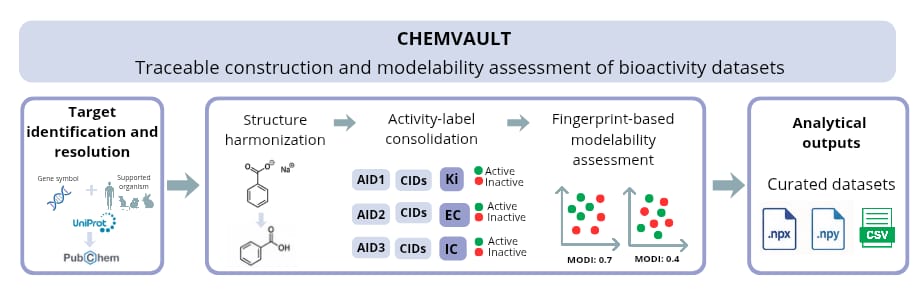
Figure 1. Target-centered bioactivity workflow in ChemVault.
ChemVault retains source tables and records the origins and operations of derived tables. Persisted jobs expose progress and terminal outcomes. Analysis exports include identifiers and provenance for their associated populations and fingerprint representations.
Documentation
- Usage covers installation, execution modes, dataset construction, scientific workflows, storage, and exports.
- API Reference documents the supported FastAPI endpoints, backend gateway, persisted job contracts, and execution distinctions.
- Changelog includes the authoritative root changelog without duplicating it.
Citation
Contreras-Torres, F. F., Murrieta, A. C., Castro-Flores, D., Saldívar-González, F. I. (2026). CHEMVAULT — Traceable Target-Centered Bioactivity Dataset Construction and Modelability Assessment. Zenodo. https://doi.org/10.5281/zenodo.23378448
Use CITATION.cff as the authoritative machine-readable citation metadata for ChemVault. Citation metadata is updated with each release.
License
ChemVault is licensed under the
GNU Lesser General Public License v3.0 or later.
The SPDX identifier is LGPL-3.0-or-later.